

Amazon bought the television rights to J.R.R Tolkien’s series of novels, the Lord of the Rings, in November 2017 for $250 million, and 5 years later, the first fruits of their labour are finally ripe for the pickings. So, is the Rings of Power worthy of Smaug’s hoard or is it something to be buried in the Mathom House at Michel Delving?
The show centres around the story laid out in The Silmarillion written by Tolkien as a collection of myths and tales in both verse and prose from the Second Age of Middle Earth, thousands of years before the events of The Hobbit and The Lord of the Rings. While spending $465 million on making a tv show based on some poems that are the Middle Earth version of works such as Beowulf or The Iliad is certainly a risky move on Amazon’s part, it seems that unlike almost everything else to do with Jeff Bezos, this show isn’t just about dosh as fast as possible, although like everything to do with Jeff, it does come with a price tag.
Quite a hefty one at that, as mentioned previously this show cost $465 million (£404 million) to produce, that’s just over $58 million dollars for each episode, which equates to $1 million for every minute of screen time, considering each episode is just short of an hour long. It is immediately clear where all this money has gone, and it is not right into Lenny Henry’s pocket, although I am sure he will not have to partake on the Great Harfoot Migration, looking for work anytime soon.
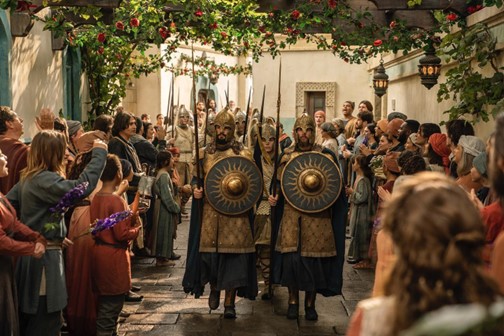
The visual, practical, and special effects are astounding. As the camera pans over such legendary locations like Numenor, Harad, the Grey Havens or Lindon, it is clear that the artists and designers have put in vast amounts of work to render these places from the legendarium in such exquisite detail. Let me make this clear, even if you dislike the characters, the writing, the story, whatever, the visuals in this are far superior to anything seen before in the Lord of the Rings cinematic universe, let alone anything seen on a TV show of all things.
If some of those locations sound a little unfamiliar to you, fear not, for this show does also travel to such iconic locations from the other films such as the Mines of Moria – (Or Khazad-Dum, if you are inclined to speak Khuzdul), and of course our old friend Mordor. But the reason places such as Hobbiton, Minas Tirith, Isengard or Helm’s Deep aren’t mentioned or seen yet, is not only because these places don’t exist yet, but also because Amazon are leaning heavily on these new places and characters such as Halbrand, a character invented for this show, or more minor characters from the previous films like Elrond, Galadriel and Isildur to lead this show, as a way to entice old fans with nostalgia, while still providing new characters for new audiences to relate to.
With the introduction of these new characters, it was inevitable that there would be some backlash from fans, and this show has been mired in controversy and allegations from fans of Tolkien’s work and fans of review-bombing shows. Even before the first episode of the series was released, people had been leaving one-star reviews on review aggregate websites such as Metacritic, Google Reviews and Rotten Tomatoes, simply because they dislike the fact that non-white characters exist in Middle Earth. The absurdity of these claims can be summed up in that they are complaining about the fact that in a fantasy universe where wizards, dwarves and dragons exist, some made up characters have a different skin colour.
Of course, representation is wholly a good thing, but some feel that Amazon could have put more effort and thought into how to incorporate POC (people of colour) into the story, rather than ‘shoehorning’ them into a white European fantasy trope, as they have done with Arondir, a black elf in the show. Essentially the question facing the writers was: what is more important – promoting inclusivity or staying true to the source material?
Speaking of the writers, one of the main criticisms of the show that does not boil down to racial prejudice or identity politics, is the fact that for the most expensive TV show ever made, Amazon hired JD Payne and Patrick McKay, who had previously worked on…. some scrapped scenes in Star Trek Beyond which they received no credit for. That is it. Interesting choice on Amazon’s behalf. Some other criticisms levelled at the writers is that they are using the fame and notoriety of Tolkien’s work to convey their own message through the show, rather than sticking true to the original themes, instead messing with the source material, changing events and characters to suit the needs of the show, such as the introduction of new characters, like Halbrand, all the Harfoots, and the diminishing of Elrond’s character, to make way, some argue, for Amazon to push their strong, indefatigable, female protagonist, Galadriel. Others argue that this diminishing is simply part of Elrond’s character arc, and that over the course of this season, and maybe the other four seasons, which have been confirmed to be going ahead, it will develop.

In an interview with Vanity Fair magazine, ‘The driving question behind the production, McKay adds, was this: “Can we come up with the novel Tolkien never wrote and do it as the mega-event series that could only happen now?”’. Contrasted with the infamous quote from Peter Jackson about the original films – “We made a promise to ourselves at the beginning of the process that we weren’t going to put any of our own politics, our own messages or our own themes into these movies. … In a way, we were trying to make these films for him, not for ourselves.”, an interesting comparison can be drawn here.
At the end of the day, the Rings of Power is an interpretation of Tolkien’s work, books can rarely ever be directly adapted to the screen, since they are different types of media. Things that work in books, do not always work on screen – characters that can be introduced with a few lines in a book from the point of view of the narrative voice have to be introduced using dialogue and visual cues on a screen, meaning that new material must be made when it comes to adaptations like this.
So, what do I really think about this show? Well, you probably have noticed that so far in this review there is nothing resembling a plot summary. This is not only to avoid spoilers but also, the story is convoluted, and all over the place at times. Multiple different viewpoints from Galadriel facing the storms of the Sundering Sea, to Elrond dining in the Mines of Moria, are cut and interspersed with other more down-to-earth viewpoints, like the villagers of Harad, the Harfoots along the River Anduin, which albeit does give the impression of a grand epic tale, that concerns all of Middle Earth and further, it also feels a little disjointed. While the graphics are incredible, it cannot help the fact that this show feels like it would benefit from splitting these different viewpoints into different episodes. The sudden change from gritty action scenes to the pleasant, plodding plotline of the Harfoots is slightly eased by music cues and stunning transitions across a CGI map of Middle Earth, but it cannot change the sense of disconnection between the disparate viewpoints.
The dialogue is dry, and long winded at times, but feels suitably Tolkien-like, that it does not impede upon the show as much as it would for a show that was not based on an early 20th century fantasy novel. The cast is comprised of a suitably diverse set of experienced actors, but the standout is certainly Daniel Weyman as The Stranger, who manages to portray a frail yet powerful and lonely foreigner in an alien land, with barely any lines, simply through body language and visual cues. Lloyd Owen as Elendil is another highlight of the show, his portrayal of a Numenorean captain, and subsequently Chief of the Dunedain, is rugged and a perfect contrast to Morfydd Clark’s elegant yet aggressive Galadriel. Elrond is done a disservice in this show, with the writers choosing to make him more of a shallow prop of a character, to move the plot on and function as a mere filler.
Overall, I am divided about this show. As a TV show it is hard to say that it is much better than what is available on other streaming services, although the visual effects certainly look a lot better than anything else out there at the moment. As a fan of Tolkien’s work, its hard not to be irritated by the corners cut by Amazon and the parts of the legendarium that have been discarded, but at the same time, the fact that we are getting a show about events and characters as obscure as this is a fan’s dream. Personally, I think that although this show certainly has its flaws and its merits, we should ride this slightly above average first season while we can, as who knows when it will end.
7/10
By Oliver Godkin
All photo credit: @lotronprime on Instagram.


 The 1509