

Written By James Inglis
On the 1st of December 1949, Pablo Emilio Escobar Gaviria was born in Rionegro, Colombia. He would grow up to become the richest criminal of all time, controlling 80% of all cocaine being trafficked across the world. At the peak of his wealth, Forbes placed him as the 7th richest man alive with a net worth of an estimated $30 billion in 1989 which is equivalent to $70 billion dollars as of 2022. This fortune was accrued over years as the leader of the Medellín Cartel which monopolized the cocaine trade into the United States. Pablo Escobar was both a drug lord and a narcoterrorist due to the series of public shootings, bombings, sieges, funding of extremist guerrillas among other terrorist actions he orchestrated throughout his tenure. Eventually however, his cartel crumbled, and Pablo’s life of luxury was ended when he was forced into being a fugitive before his ultimate death on the day after his 44th birthday in 1983.
Although Escobar was born in Rionegro, he grew up in Medellín in the Department of Antioquia in the northwest of Colombia and this was the place he would recognize as home. He is not known to have had any notable incidents in his young age throughout his schooling until he eventually left high school in 1966 at the age of 16. It was at this time that Pablo Escobar began his criminal career. After spending two years on the streets of Medellín as a little-known criminal he returned to high school with his cousin Gustavo Gaviria who he would go on to found the Medellín Cartel with. During the time they spent at high school, after returning, they were viewed by teachers and pupils alike as gangsters and bullies before they both eventually dropped out a year later. Gustavo Gaviria ended his education there, however Escobar forged his high school diploma and went to study at college with the hopes of becoming a criminal lawyer and eventually president. Although he was forced to give up due to financial difficulty, this was a dream that Escobar would revisit years later.
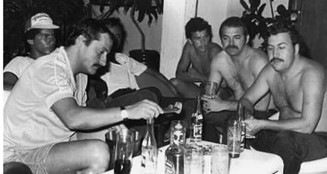
Pablo Escobar’s criminal career allegedly started off with small-scale street fraud after leaving high school in 1966. However, after dropping out completely with his cousin, he escalated his crime to working with organized car theft gangs. Pablo and his gang would dismantle stolen cars and sell the parts for profit. Escobar began making enough money to the point that he had to spend a portion of his revenue on bribing officials to launder his money. Allegedly this initial crime led Pablo into a prison cell for several months before he turned 20. By this time, Pablo was also notorious among the world of car thieves. Soon Pablo became involved in more violent crime in which he would kidnap people who owed him money and then demand ransoms for their release. Famously, Pablo Escobar kidnapped prominent businessman and philanthropist Diego Echavarría in the summer of 1971. He demanded a ransom of $50,000 from Echavarría’s family which was paid to him. However, despite this, Echavarría was still killed. This single action brought great infamy to Pablo and his gang.
After a decade of organized crime committed by Pablo Escobar, the cocaine trade began in Colombia in the mid-70s. Escobar entered this trade through the assassination of one of Colombia’s first drug traffickers, Fabio Restrepo. After his death under the order of Escobar, he seized Restrepo’s cocaine market in 1975 leading to an extremely rapid rise to power in the cocaine trade for Escobar. However, his success was soon marked with an event that would come back to haunt him in the future. In May 1976, Escobar was arrested by the Colombian authorities on the charge of drug trafficking into Ecuador after 39kg of cocaine was found in his spare tire. The mugshot taken as a result of this arrest is the most famous image of Escobar as he grins despite being in custody. The reason for this lack of worry was well-founded given that all charges were dropped against Escobar after bribing the judge. The arresting officer was assassinated a year later. This method of dealing with law enforcement became signature of Escobar and it was given the name ‘plata o plomo’ which is slang for ‘money or bullets.’
Pablo’s operation worked on a smaller scale initially, however in April 1978 he met with other drug lords to form the Medellín Cartel. After the formation of the cartel, drug trafficking volumes increased massively and by the end of 1978 the cartel had trafficked approximately 19,000kg of cocaine into the United States. As demand for the drug grew, Escobar organized more shipping, smuggling and distribution routes into California, Puerto Rico and South Florida (particularly Miami). A co-founder of the Medellín Cartel, Carlos Lehder, was instrumental in this as he and Escobar worked together to develop a trans-shipment point on Norman’s Cay in the Bahamas in 1978. This became the central smuggling route for the cartel between 1978-1982. Pablo purchased the land with the help of criminal financier Robert Vesco and developed it into an area of luxury. It contained a 1km airstrip with aircraft, a harbor with boats, a hotel, housing and a large, refrigerated warehouse to store cocaine. Using the profits he had made from this smuggling route, Escobar spent millions on a large plot of land in Antioquia upon which he built his luxury home known as ‘Hacienda Nápoles.’ His home was complete with a zoo, a private airport, a bullring, a brothel and even an entire Formula 1 racing track.

Despite his criminal activity, Escobar was well-known by the people of Medellín as a philanthropist. He built roads, power lines, football fields, housing for the homeless and he spent millions on developing the poorest barrios of Medellín. He was also known for paying his workers in cocaine labs handsomely (relative to what was typical). With this positive reputation from the public in mind, Escobar began to pursue his earlier dreams of becoming president once again as he entered politics in the late 1970s. In 1982, Escobar entered Congress. According to the law at the time, Escobar was granted parliamentary immunity and the right to a diplomatic passport as a result. His prominence in Congress and philanthropic acts earnt him the moniker ‘Paisa Robin Hood.’ Due to the fact that he was now in Congress, his criminal activity had to be kept clandestine and so he claimed that his fortune came from a bicycle rental company he had set up at the age of 16. However, soon the newly appointed attorney general of Colombia in 1983, Rodrigo Lara Bonilla, accused Escobar of criminal activity. The consequences of Escobar’s previous arrest for drug trafficking in 1976 were in full display as the arrest was investigated for a few months before Liberal leader Luis Carlos Galán expelled Escobar from the party. Escobar fought back against this decision to no avail, and he eventually announced his retirement from politics in January 1984. Attorney general Bonilla was assassinated just three months later.
In the mid-1980s, after Escobar’s departure from politics, the Colombian judiciary was placed in his crosshairs. Many judges were bribed and murdered in accordance with Escobar’s ‘plata o plomo’ policy although he eventually made a request to surrender to the Colombian government as long as he was guaranteed to not be extradited to the United States as he believed it was his best option at the time. This request was rejected and so Pablo along with other drug lords from the Medellín Cartel went onto found the narcoterrorist organization known as ‘Los Extraditables’. It was started as a means to pressure and intimidate the Colombian government into outlawing extradition on a constitutional level. As part of Los Extraditables, Escobar worked with and financially supported the far-left extremist guerrilla movement known as M-19. On the 6th of November 1985, M-19 sieged the Supreme Court leading to the death of over half of the supreme court justices with many others being killed, injured or kidnapped in the ensuing violence. Large amounts of paper evidence on Escobar were destroyed in a two-day long fire with many suspecting that due to Escobar’s support of the group, it was purposefully done by members of M-19. This became one of the deadliest attacks in the history of Colombia and it was an embarrassing failure for the military.
Years later, Escobar still held a grudge against Galán for expelling him from the party and so he had him assassinated at a campaign rally for the 1990 presidential election on the 18th of August 1989. However, this assassination was not solely motivated by a grudge. Many drug lords including Escobar believed that Galán’s election would lead to a strong push to extradite to the United States and so corrupt politicians, military officials and drug lords conspired for his assassination. After Galán’s assassination, his successor César Gaviria was poised to become president. Escobar also attempted to assassinate César Gaviria in his first major act of narcoterrorism. Escobar believed César Gaviria would be on Avianca Flight 203 and so planted a bomb on the plane. Ultimately, César Gaviria did not board this flight. Instead, the bomb detonated which killed all 107 civilian passengers as well as 3 people on the ground. The passengers killed in the explosion included two American nationals which prompted the U.S. government to begin directly intervening with Escobar.

César Gaviria was ultimately elected as the 28th president of Colombia and inaugurated on the 7th of August 1990. His administration began to move against Escobar and the drug cartels and after lots of negotiations they finally managed to convince Escobar to take a deal to surrender and cease all criminal activity in exchange for a much-reduced sentence and preferential treatment in his incarceration of just five years. This declared the end to a series of narcoterrorist actions committed by Pablo against Colombia in an effort to pressure the government and public opinion. Under Escobar’s orders, bombs were detonated in public areas, many were kidnapped and executed, law enforcement agents were massacred, public shootouts took place and much more. On the day of his surrender, the new Colombian Constitution of 1991 was approved and passed which controversially prohibited the extradition of Colombian citizens to the United States. The job of Los Extraditables was done. Many viewed this as a sign of weakness from the government as they caved into the pressure put on them by the narcoterrorist actions that had been committed by the Escobar. Pablo Escobar surrendered on the 19th of June 1991.
Despite his surrender and subsequent arrest, Escobar was far from being in a poor position. As part of his preferential treatment, he was given several extremely generous rights. Firstly, he constructed his own prison known as ‘La Catedral.’ The ‘prison’ was luxurious and featured a football pitch, a bar, a jacuzzi, a waterfall, a view of Medellín from the mountains and hardly any security measures. It was also supplied with a large stockpile of weaponry and ammunition so that Escobar and his sicarios would be able to fight back in the event of an assault. Furthermore, Escobar was allowed to prohibit any military personnel from guarding the prison and instead he was allowed to select his own guards. Of course, he chose only his most loyal lieutenants and sicarios. During his time in La Catedral, Escobar continued his drug smuggling activities despite the agreement with the government to cease all criminal activity. The Colombian government simply turned a blind eye to this as at least bombs were not being detonated in public streets and law enforcements agents were not being massacred by the 100s. However, this arrangement ultimately fell apart when it was reported that Pablo had four of his lieutenants tortured and murdered within La Catedral. Following the unveiling of these events, the Colombian government attempted to move Escobar to a more standard prison for the remainder of his prison sentence which unsurprisingly Escobar refused to agree to. Instead, the Colombian National Army surrounded La Catedral in an attempt to capture him however due to Escobar’s influence and reach, he discovered this plan early and made a successful escape. Despite being surrounded by the military, Escobar is said to have simply walked out of the back gate thanks to the bribery and intimidation of corrupt soldiers. After 13 months in La Catedral, Escobar was once again on the run.
Following his escape, the manhunt for Escobar employed a group of 600 soldiers collectively known as the Search Bloc and their sole objective was to capture Pablo Escobar under the command of Colonel Hugo Martínez. These soldiers were specially trained by the United States special operations counter-terrorism force known as the Delta Force to be incorruptible and as effective as possible. In addition, a paramilitary vigilante group was formed under the name Los Pepes (Perseguidos por Pablo Escobar, People persecuted by Pablo Escobar). Their objective was to cripple the Medellín Cartel and kill Pablo Escobar. The group was financed by and comprised of rivals in the cocaine trade who wanted to end Pablo’s control over 80% of the world’s cocaine trafficking, those who had been affected by Pablo’s extremist narcoterrorism and far-right paramilitary leaders who became aware of Pablo’s affiliation with the far-left guerrilla movement M-19 in the Supreme Court Siege of 1985. The major rivals of Pablo Escobar, the Cali Cartel, were the main financiers behind the group. The paramilitary figurehead for the group was the far-right militarily trained Carlos Castaño. Los Pepes waged a bloody campaign against Escobar and the Medellín Cartel assisted by clandestine contracts between them and the Search Bloc. They killed several hundreds of Escobar’s associates, sicarios, lieutenants, relatives, friends, accountants, lawyers and more. Many of them were tortured, interrogated and executed before being publicly displayed on the streets of Medellín, presented being flayed or hung as a message to Escobar. They were also responsible for the destruction of labs and property belonging to the Medellín Cartel as well as the destruction of two estates belonging to Hermilda Escobar, Pablo Escobar’s mother. This series of attacks against the cartel began to cripple Pablo’s drug trade and the Medellín Cartel as a whole began to crumble.

At this point in time for Colombia, the violence from Los Pepes, from between rival cartels and drug lords, from Escobar’s narcoterrorism and from the very high number of street criminals placed Colombia as the murder capital of the world. Over 25,000 violent deaths were reported in 1991 and over 27,000 in 1992. This was further fueled by the large bounty that Escobar had placed on the head of any police officers in Colombia for his sicarios if they could show that they had murdered them. Escobar himself was now also on a downwards spiral and the peak of his tenure and wealth had come to an end.
After 16 months of Pablo being on the run since his escape from La Catedral, the manhunt for him finally led the Search Bloc to the middle-class residential area of Medellín known as Los Olivos. With pressure being put on Escobar from the Colombian police, the United States government, Los Pepes and the Cali Cartel, Escobar was discovered with his bodyguard and driver thanks to technology provided to the Search Bloc by the United States. The technology was used to track Escobar to a household after a signal was pinpointed from a call Escobar made to his son, Juan Pablo. The police initially intended and attempted to arrest and take Escobar into custody peacefully so that he could face the justice system and truly answer for the crimes he had committed. However, the situation unsurprisingly rapidly turned into an exchange of gunfire between the soldiers of the Search Bloc and Pablo with his bodyguard. His bodyguard, Álvaro de Jesús “El Limón” Agudelo was the final remaining loyal servant to Escobar. All the others that were once loyal under the command of Escobar had either been killed by Los Pepes or in a gun fight, incarcerated and extradited to the United States, left in a Colombian prison cell or they had defected and switched over to working and fighting for Los Pepes against Escobar. El Limón was ultimately killed by machine gun fire from the Search Bloc soldiers whilst Escobar made an attempt to escape from being killed or captured via the rooftop. Despite his attempt to flee, he was hit several times by bullets in the torso and feet which brough him to the ground. Finally, a bullet was shot through his ear which marked the end of the reign of terror of history’s richest criminal, Pablo Emilio Escobar Gaviria.

 The 1509