

Written By Adethya Srinivasan
The Guildford library, located on North Street in Guildford (51.2368° N, 0.5719° W), is the chosen area of gathering for the young and old alike. Catering to all ages and interests, the building is a humble encyclopedia which brings together different peoples from different walks of life.
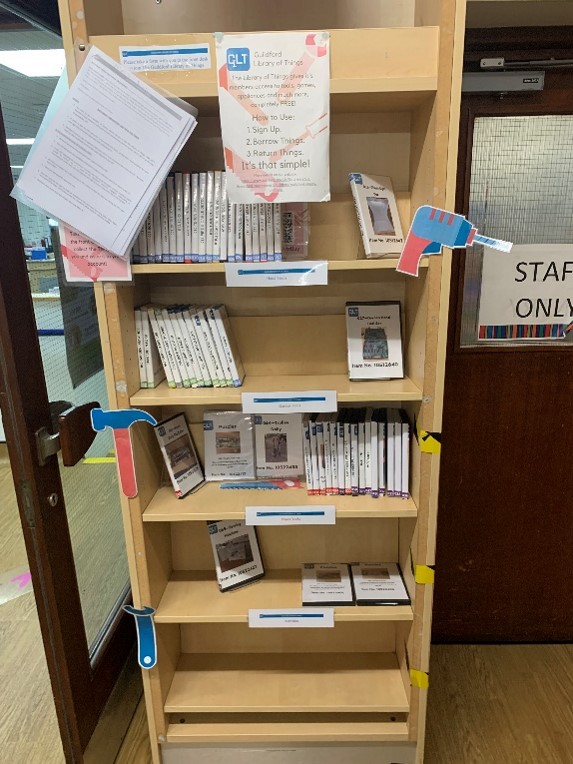
The library lends many things beyond just books and DVDs. There is, of course, access to the library’s own computers and internet and as part of its ‘Guildford Library of Things’ various tools can be borrowed from the library. From sewing machines to garden leaf rakes, chances are the library lends it.
On the first floor, the wall is lined with pamphlets for events happening in and around Guildford as well as advertisements for clubs and societies run in Guildford. The library itself runs reading sessions for children every Monday and Wednesday at 10:30 am (Pebble rhyme time, Storytime).

Spotted around the library, there are Guildford library suggestions, which are changed on a frequent basis. Personally, I find that these suggestions lead me to genres which I otherwise would not have considered. To ease the current cost of living crisis, Guildford libraries ‘Warm Welcome’, provide hot tea and coffee to visitors as well as a space to stay out of the cold.

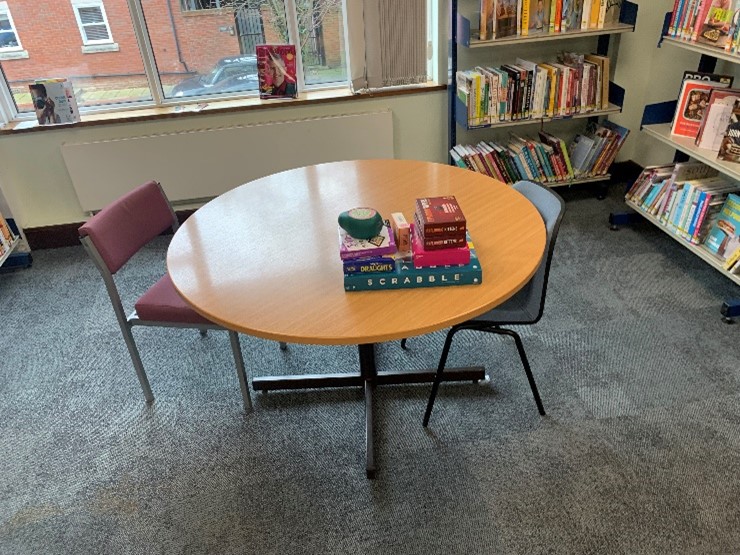
The library has installed more tables considering the increasing student demographic who use the library as an area for quiet study. Despite an often, overwhelming, number of youngsters at the library, the ambience is always peaceful, maintaining an average of 48.6 dB, observed over a five-day period.
User data tells us that there is a decrease in the use of libraries amongst the adult population in the UK, which by contrast is increasing amongst children. However, both nationally and in Surrey, book borrowing has seen a downward trend over the last ten years.
(All data referenced below is taken from the Active Lives Survey 18 month dataset, the CIPFA Library Survey, Surrey’s Library and Culture Services Strategy and the Office for National Statistics.)
This data was taken between mid-November 2015 and mid-May 2017.
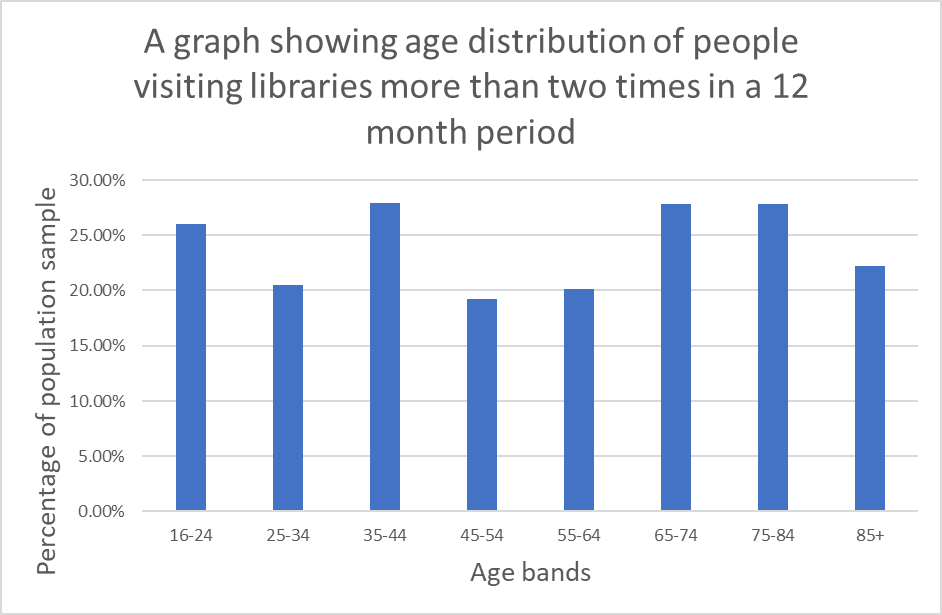
Shown here is the number of people as a percentage of a sample population who visited a library more than two times in a 12 month time period. Here, the largest age group is the 35-44 band with the lowest as the 45-54 band.
A similar trend can be seen in our local libraries, yet with an increasing youth demographic compared to the national average; a likely result of the university and number of schools found in the local area.
Looking at the distribution of frequent library goers on a regional basis will provide more insight on how Guildford library performs against the national average.
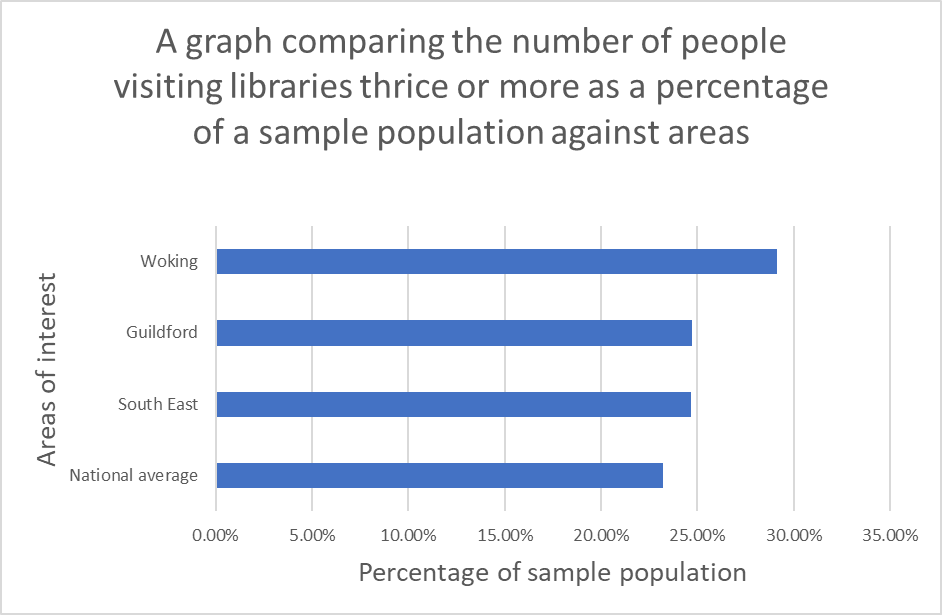
As we can see here, the South East has a larger library demographic than the national average and both Guildford and Woking are greater than the regional average for the South East.
In alignment with the national trend, in person library visits have also decreased in Surrey.
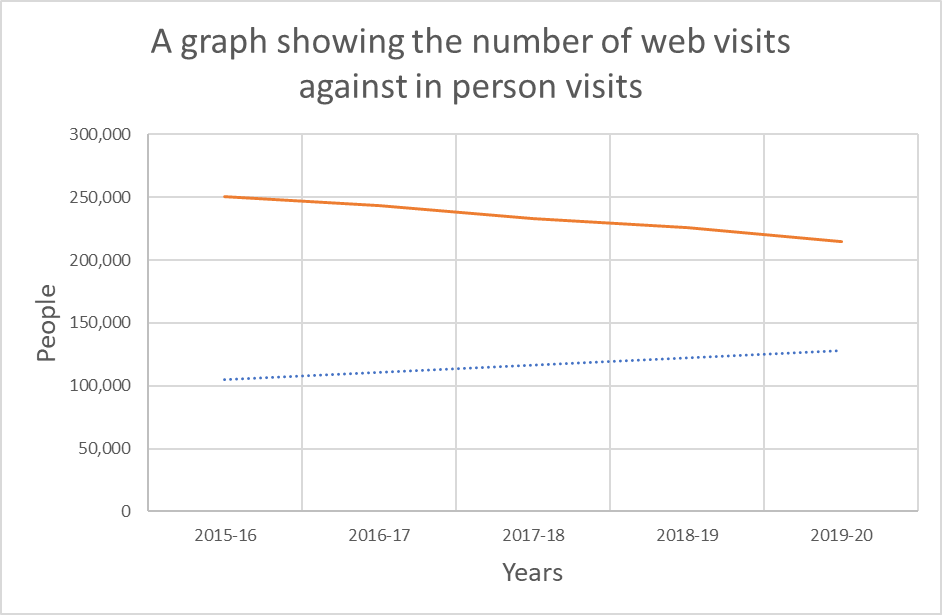
Over a 5 year period, there has been a 14.4% decrease in library visitations, however website visits have seen a 25.8% increase (where the blue dotted line is web visits and orange solid line is in person).
Though these stats may not suggest a ‘cancellation’ or a net positive in library usage across the UK, they do, however, suggest that more people are opting for online library services.
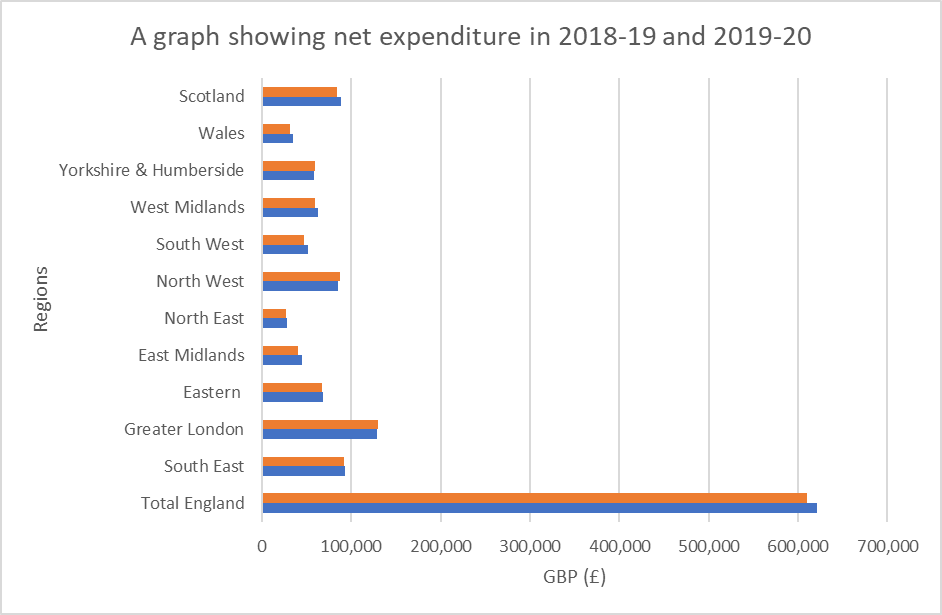
The graph above shows net expenditure in each region (blue is 2018-19 and orange is 2019-20). Most regions have experienced a net decrease in expenditure during this period.
In conclusion, despite an overall decrease in visitations, the library service continues to have significant reach. Not only does the service provide books to borrow, but also various other services like borrowing tools, internet connection, DVDs etc. Libraries are an integral part of many communities and a decrease in expenditure at a time where they ought to be digitalizing where possible and catering for the needs of the community, does not bode well for our libraries.




 The 1509