
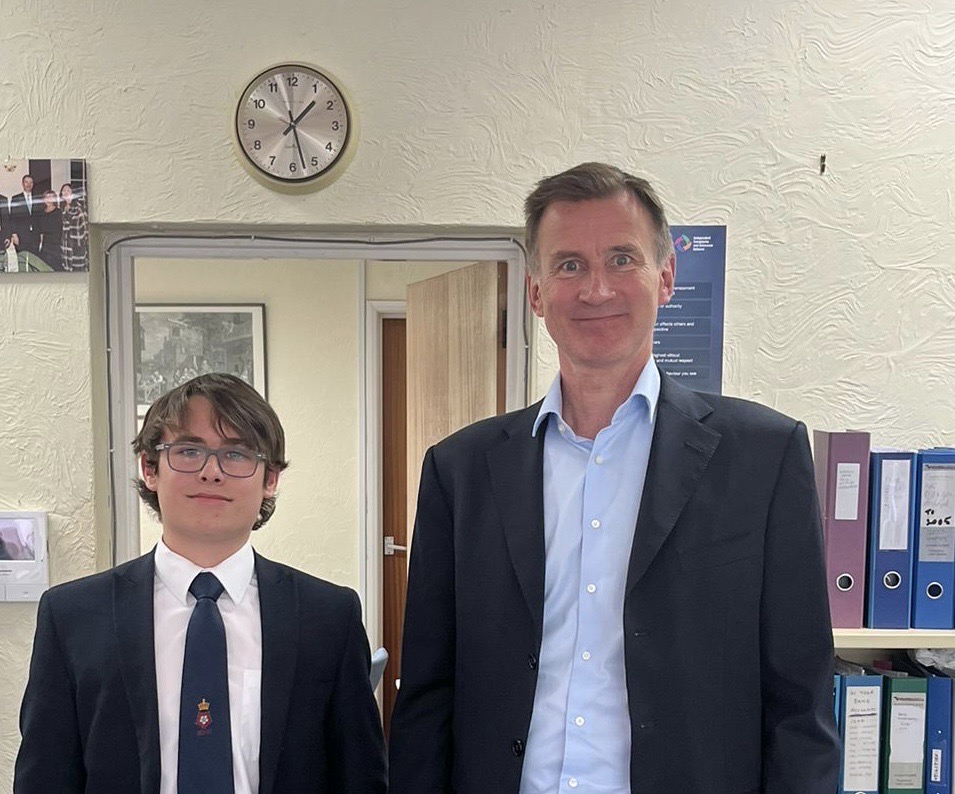
Joshua Inglesfield interviews the Chancellor of the Exchequer, Jeremy Hunt.
In a small office tucked away in the housing estate of Tilford Road, the Chancellor of the Exchequer, Jeremy Hunt, is at work. As I am seated in the offices of his constituency staff, I see him emerge from the humble back office. He chats with his staff in the way you might expect a favourite teacher to chat with their class – respectful of him, yet comfortable in conversation. He approaches me in a manner which indicates a personality a far cry from what others may have you believe of the Chancellor, or any politician at that. Soon seated in his small office, I take a tangent from the rank-and-file questions a broadsheet reporter might employ – instead choosing to focus on the topical issue of young people and democracy.
Hunt clearly has a desire to rectify young people not being involved in politics, expressing concern with; ‘they’ve never been as involved in politics as I would like’ – however he presents it as an issue of expression rather than formation of views. He states that ‘what I find is young people tend to be very connected to or involved in causes but not necessarily political parties’, suggesting while young people have formed opinions, they struggle to express them in a political forum – something Hunt encourages. He emphasises that while it’s ‘fair enough’ if you don’t join a political party, ‘in the end if you want to make progress in all those causes the way you do it is through our political system and for that you need to join a party’. Many young people, however, are wary of attaching themselves to such a firm institution as a political party so early – so I ask Hunt what else can be done to increase the connection of young people to politics and democracy. He shifts the need for action over to his court – the MPs. He argues that as well as young people needing to get involved, ‘those of us in politics need to make sure that we have a message of hope for younger people’, emphasising that ‘there’s lots of challenges in the world’ and ‘sometimes we forget to convey simple but rather exciting truths like the fact that if you were to choose one time in human history to be born the best time to be born would be right now’ – evidently aiming to push across a sense of optimism in what is a daunting time both economically and socially in Britain. He elaborates with ‘the world is a much better place than it was 50 or 100 years ago’ – reflecting on his own outlook as a British schoolboy ‘when I was at school we were worried about a nuclear war, we had about half the world’s population living in absolute poverty, and very small numbers of countries were democracies – that’s improved beyond all recognition’, thus conveying both a sense of a continuous upward trend for humanity, and one of gratitude for where we are now, the very conveyance he urges his fellow politicians to do. While he does concede that ‘we have new challenges’ such as climate change – he states that he is ‘convinced we will be able to tackle’ the climate crisis and that ‘we have a world with many many more opportunities than anything I could ever have imagined when I was a teenager’. Perhaps then it is this optimism and upbeat attitude that politicians must permeate past the filter of the media in order to create a political landscape young people actively want to participate in.
‘Those of us in politics need to make sure that we have a message of hope for younger people’
Hunt’s focus on change and advancement from the past to today begs the obvious question: what of technology and social media in involving young people in politics? Hunt has rival opinions on this, initially stating that ‘technology is a brilliant way of making it easier for people to engage’ – but he is also quick to offer a caveat; ‘social media has its pitfalls’. He elaborates on the harmful language we so often see hurled around sites ‘it can be a very aggressive forum where because you’re not seeing someone face to face they would use language that they wouldn’t use if they were actually with you in person’, pointing to how ‘we’re still figuring out the rules and the way to make social media a place where you can have sensible, robust, but decent discourse’. He finishes our foray into social media with a sense of hope for its future use, stating that ‘definitely it’s a great way to get involved’.
Potentially one of the most difficult and long raging debates in politics is over the voting age – a topic made even more contentious by the Labour Party’s recent suggestion that they are considering extending the franchise to 16- and 17-year-olds – a move which I was keen to get Hunt’s thoughts on. Hunt immediately confirms his position that he believes 18 ‘is the right age’ for voting, alongside offering a rather dim view of Labour’s motivations ‘Labour want to do it because they think the majority of 16 to 17 year olds would vote Labour – that’s their motive for it’. Hunt feels that lining up the voting age with the end of full time education is the right action ‘you are still in full time education until the age of 18 and that’s why I think it’s the completion of full time education that’s the appropriate time to cast your vote’ – yet still suggests under 18s should educate themselves on politics ‘that doesn’t mean to say you shouldn’t learn a lot about politics in the meantime’. While he admits it would be a ‘hotly debated’ topic in the Commons and Lords, he again references his own childhood as basis for his view ‘I think my own views were not fully formed until I was 18’, as well as pointing to a need for pluralism in what views citizens are exposed to prior to joining the electorate ‘I think it’s good to recognise that it takes some time for people to get exposure to lots of different political viewpoints’ – implied as a process reasonably advanced at the end of full time education. The emphasis Hunt places on being exposed to a range of political views emerges even further when I ask him to justify why a politically literate and active 16–17-year-old (of which there are many) should wait until 18 to be enfranchised. He replied with ‘we say that full time education must last until 18 for a reason – you are still developing your thoughts and getting exposed to different viewpoints’ and continues with further reference to his own experiences; ‘it wasn’t until I was 18 that I had really come to a balanced view of what I thought’. Overall, he concludes that ‘you have to draw the line somewhere and my view is that 18 is the right place’.
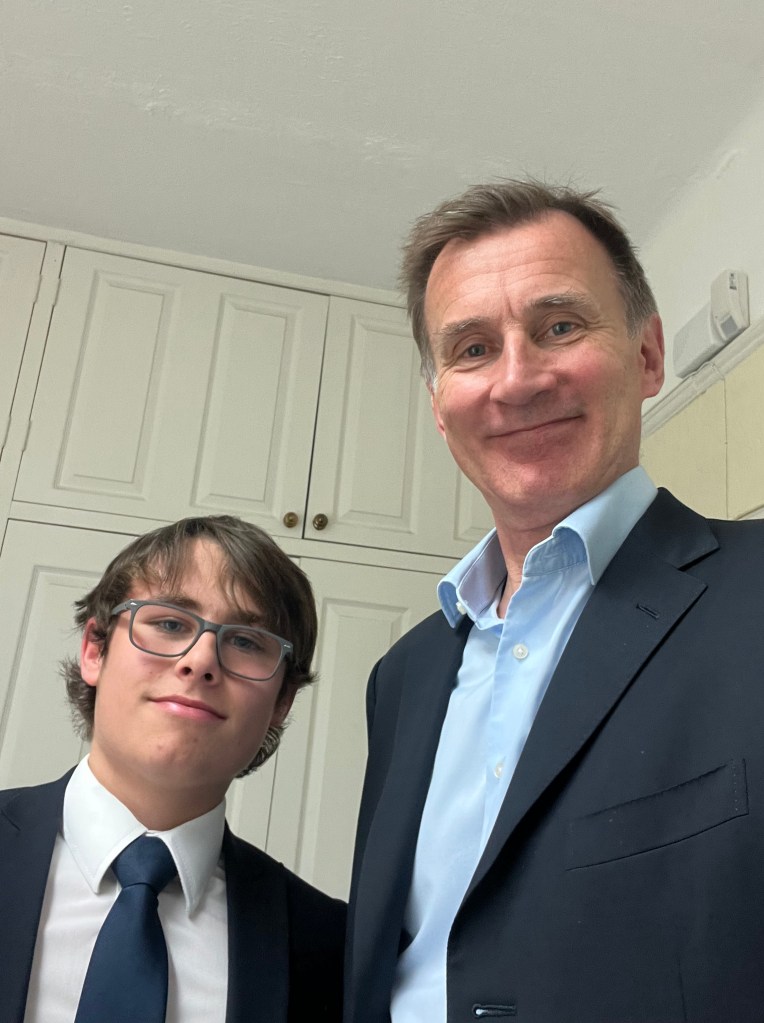
With regards to connection between young people and politicians, Hunt urges politicians to interact with their constituents more ‘the main thing that politicians have to remember is to spend a lot of time communicating – don’t just spend your time running the country – actually talk to the people whose country you’re running’ – emphasising that politicians must remember that ‘we work for the people, they don’t work for us’. He also urges young people to ‘get involved in campaigning for the issues that you care about’ and meet your MP – highlighting that everyone can meet their MP at a surgery. Hunt seems committed to this notion of communication between MPs and constituents, particularly as ‘what you’ll find out is that they’re not so different’ and ‘they’re human beings’, noting that ‘we’ve all got our faults’. He clearly has a desire to get constituents to realise that politicians are not distant entities, stating that ‘we need to destroy this narrative that politicians are all in it for themselves’ – an issue I feel has been escalated by the last few years in politics. He again puts the onus on politicians to change the landscape ‘it’s up to politicians to get out there and meet people’, he comments, something he explains he tries to do in his constituency ‘the whole time’. He also reflects on how he is still able to connect with his constituents in such a manner despite his role as Chancellor of the Exchequer, stating that ‘one of the great strengths of our political system is even if you’re prime minister or chancellor, you’re still a constituency MP’ – and so still ‘go out and knock on doors and meet people’. In fact, rather than being any detriment, Hunt presents his twin roles of constituency MP for South West Surrey and Chancellor as a great benefit for Britain. While the two undoubtedly mean he is a busy man, ‘you get good at juggling’ as Hunt puts it – however as previously referenced constituency work influences his economic policy ‘it’s through meeting ordinary voters that you understand what the pressures are that people are facing’. Hunt states that ‘because of decisions I’ve taken we’re giving every family about £3000 of help this year and last with their energy bills and other cost of living pressures’ – decisions taken, he says, ‘because I’ve talked to a lot of people and I understand what the pressures are that they’re facing’ – leading him to conclude that ‘it’s really important to stay in touch’.
‘We work for the people, they don’t work for us’
‘It’s really important to stay in touch’
I then wanted to delve into his economic policy, having learnt what influences it, but specifically for young people. What will the Chancellor and Treasury do to help young people like us? Hunt’s priority, he tells me, is to get the economy into a workable state; ‘the most important thing I can do for young people is to get the economy motoring so that you have great jobs waiting for you when you leave university’ comments Hunt. Hunt however is also concerned by the state of the property ladder ‘I would also like to do more to encourage young people to save more’. Hunt says he wants to do this ‘so that they’re (young people) able to put a foot on the housing ladder when that time comes’ – but Hunt doesn’t just want economic advancing. He comments that ‘I want young people to feel that we are a country that shares their values’, urging that ‘it’s really important that we continue to prioritise climate change’ – and pointing to our reduction in emissions to a greater extent than any other major country as a source of pride for him, showing a genuine concern for the causes young people hold dear to them. So, while Hunt holds value to his economic policy helping young people, he also emphasises that Government must shape Britain to fit the beliefs of young people ‘I think it’s about connecting with people practically but also in terms of their values’.
‘The most important thing I can do for young people is to get the economy motoring so that you have great jobs waiting for you’
Finally, I ask Hunt what one step he will aim to do to involve more young people in politics; ‘spend more time engaging on social media’ comes the response. Jeremy Hunt is clearly a forward-thinking Chancellor ready to adjust to an increasingly digital age for the youth vote the Conservatives need so dearly.



 The 1509