
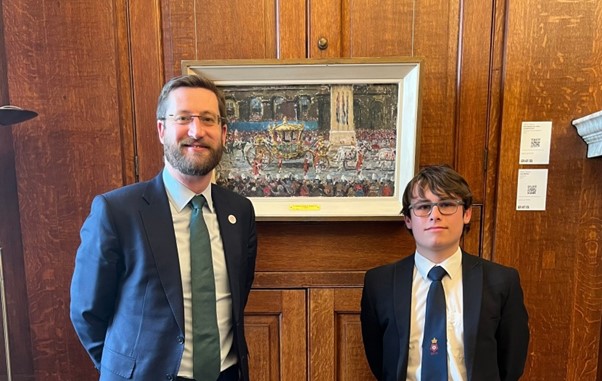
Joshua Inglesfield interviews the Cabinet Secretary and Head of the Civil Service, Simon Case – 04/05/2023
In a grand office set in the heart of 70 Whitehall, the Cabinet office, sits Simon Case – an elusive and discrete actor who is crucial to the screenplay of Government. The office is immediately impressive – adorned with a portrait of her late Majesty Queen Elizabeth II and a tasteful painting of her coronation in 1953. It is furnished with a fine polished desk, a large meeting table which one can only imagine has seen the greatest figures in government, and a comfortable sofa. I comment upon the sofa as upon entering Mr Case immediately beckons for me to take a seat on the settee – a first impression of friendliness. This continues throughout the interview – Mr Case is approachable, the reverse of the caricature of top Whitehall officials. He is not uptight nor stern, but rather someone you might imagine chatting to at a café – a refreshing and relieving contrast to the austere surroundings more suggestive of bygone days of classical establishment.
What exactly is the civil service? Given its very nature it largely remains hidden from the public eye – MPs make the headlines, and the civil servants stay in the shadows. Case boils down the civil service to “people working across the whole of the UK in lots of different areas of government” – identifying two broad categories of civil servants; those who work “to support ministers in policy making – so preparing advice for ministers to take their decisions and supporting them in Parliament”, and those who Case refers to as “Operational Delivery Professionals” – “the people who are actually out on the ground day in and day out all over the country who are directly delivering public services to the people of this country”. This includes functions such as HMRC (taxes) and DWP (job centres, job support, and benefits). Case gives the impression of a cohesive and effective civil service, pointing to the Coronation preparations as a stellar example of collaboration between civil servants, the armed forces and police, as well as local government in the run up to arguably the greatest logistical challenge faced by authorities in recent years – a challenge which seems to have exemplified the performance of the civil service, given the spotless Coronation.
With such large-scale operations comes a necessity of collaboration with the elected government of the day – a special relationship between the civil service and government, something Case is placed perfectly to offer view on. He initially offers a term used laughingly by his previous professor, Peter Hennessy, to describe the civil service; “the permanent government”, a phrase which while emphasised by Case as being offered half-heartedly offers some insight into the power wielded by the organisation which Case oversees. He is quick to assert that “we are politically impartial, we are supposed to stay the course and whoever the elected government of the day is, our job is to support them” – a position which makes it clear that impartiality is what upholds this working relationship.
Case goes further to make specific reference to the civil service code and its main message of supporting the government of the day. He summarises the services work with the government as “a new government comes in, sets a direction: we want to do x with the health service or y on crime or this on the economy, and it’s the job of the civil service to take that broad strategic steer, work up the options and advise” after which a minister makes a decision. The actual impact of the decision is then sent back to the civil service, Case explains, with it being implemented by the relevant department, whether it be HMRC tax professionals, or those who run job centres with DWP. It seems almost full circle, exemplifying how the civil service lies at the very centre of government, with policy revolving around it. The respect Case holds for ministers through this relationship emerges, emphasising that “Ministers actually have to take some really very very difficult decisions”, making clear that civil servants are not those making the final judgement on the policy that will change our lives, but help those who do.
So how does the relationship work in practice? Case makes it clear that much of the work is centred around London, with ministers directly interacting with civil servants in the capital in two main ways; the first is that ministers meet with civil servants, interest groups, and other MPs to debate issues and take decisions – meetings which go to the highest level, as Case recounts a (sadly far more important) meeting just hours before my arrival with the PM, Home Secretary, Justice secretary, other ministers, and other civil servants over illegal migration and small boats – meetings which occur for Case at least once a week. The second manner is work on paper – in relation to which Case paints the picture of red boxes carried by ministers containing submissions, papers with advice and options on key issues. Thus, it is clear that there exists a twofold process by which ideas are passed around Whitehall and to Parliament, allowing for the execution of policy.
“Ministers actually have to take some really very, very difficult decisions”
With so much communication and time spent with MPs I feel sure there must be some conflict between the civil service and government. Case instead gives the impression of a near perfect symphony, but how? How can the two entities collaborate so effectively? The answer, Case explains, is the extent to which the distinct roles of the civil service and the government are emphasised and known. He is able to succinctly put it as ‘the civil service advise and the civil service implement – but ministers decide’, a live example of how clear the roles are to civil servants. He elaborates; ‘once a minister has made a decision that’s it, that’s the direction we are going in and the civil service’s job is to carry out those instructions’. It is clear that, as Case puts it, a hierarchy exists which one can only imagine is drummed into every new recruit. Case states ‘they’re (ministers) elected by the public at the ballot box, they’re the government of the day’. It is this respect that steers the civil service from clashing with the government. However, efficiency does not come without difficulty – the symbiosis of civil service and government is only facilitated by hard work, with Case stating that ‘it takes an awful lot of interactions between ministers and civil servants’ to deal with complicated issues properly and that ‘sometimes it can be very very long and sort of tortuous conversations going on’.

Case has immense experience within the civil service, despite his rise to power being described with terms such as ‘meteoric’ (Tatler). He has overseen and served under Labour, Conservative, and Liberal Democrat (in the 2010 coalition) governance – and thus is placed perfectly to offer comment on how these parties with wildly ranging stances differ in their policymaking. Case first makes it clear that changing parties does not usually mean changing the structure of government, and if there is any change it is structurally minor – ‘how a government works…actually isn’t the biggest difference’ Case explains. The more evident change is instead what could be labelled ‘soft change’ – the leadership styles and personalities of the individuals in a cabinet – with whom the civil service work closely with. Case gives hyperbolised examples, referring to unnamed former colleagues, stating that ‘some people (ministers) that I’ve worked for love acres and acres of detail before they’ll take a decision, and then others will think; right, actually you can boil down this really quite complicated problem – bang – there you go, right I’ll take a decision on the basis of that’ – two styles at opposite ends of the spectrum. Case sums it up with ‘the day in day out experience for the civil service is very largely determined by the character of the individuals who make up the government and perhaps the individual ministers that you work for’.
“Once a minister has made a decision that’s it, that’s the direction we are going in and the civil service’s job is to carry out those instructions.”
One of the PM’s powers, Case explains, is what is known as ‘machinery of government’ changes – effectively the creation of government departments, which one must assume would mean some shifting in government structure as governments enter and leave office. Such actions, he identifies, ‘can really change the shape of government’ – and it’s not a never used taboo power either. Case references Sunak’s breaking up of an economic ministry to create a specific department; the Department for Energy Security and Net Zero (DESNZ) in February 2023 – however Case offers a caveat that ‘it’s rare’ for such actions to take place, and states that ‘the big chunks of our government tend to be quite stable’.
The breaking up and forming of departments suggests a colossal workload – with Case describing the process as ‘a very very large undertaking’ – requiring the movement of thousands of civil servants from one area to another. He goes on to reference ‘a huge admin challenge’, with deliberations over areas ranging from where the civil servants will sit to what the new priorities are for the department – which together result in the process sometimes taking ‘6 months or more’ for the departments to ‘truly sort of bed down’. A clearly forgivable time delay, given that, as Case mentions, many departments are the size of reasonably large businesses. Thankfully, the process, according to Case, is becoming better and developing; ‘I have to say I think we’re getting better at it’ – words that would certainly reassure shareholders should it be a business. He goes further to say that they ‘keep trying to learn the lessons’, trying to ‘repeat the good stuff and stop doing the bad stuff’.
Case indulges in a pat on the back attitude when referring to the latest spree of department creations, commenting that: ‘I feel we did them pretty well’. With the recent creations of departments, I am curious as to whether it’s an upwards trend – after all, politicians appear all the more bold (and unpopular) in their decision making in recent years. Case presents a more unpredictable landscape, stating that ‘it (department changes) goes in peaks and troughs’ – determined partly by the PM in power – ‘It sort of depends on the prime minister of the day and their priorities’. He recounts that Blair did quite a lot of these ‘machinery of government’ changes, whereas Cameron didn’t do any apart from what was needed to manage the coalition, and then with May he explains; ‘right from the outset she announced as part of her leadership campaign she would set up a Brexit department, and she would set up a trade department’. It’s clear then that it’s tricky to draw a clear trend.
Case identifies another key aspect that contributes to the numbers of ‘machinery of government’ changes – external factors. When you think of external events or factors impacting governance in recent history, one key event comes to mind; Brexit. What has now become a taboo word in politics forced change in the creation of the Department for Exiting the EU (DExEU), which Case commented on with; ‘that’s (DExEU) obviously a response to a very particular external event and imperative and so therefore the structure of government has to change’. Thus it’s clear that while switching governments can result in large ‘machinery of government changes’, Case recognises that when creating a government department ‘you’re often responding to external factors’.
Sitting at the centre of a political universe that seems to constantly twist and turn, one can only imagine that Case’s role is one of great complication – an assumption Case backs up, describing his title as ‘weird and wonderful’ – being the ‘Cabinet Secretary and Head of the Civil Service’. As Cabinet Secretary, Case portrays a figure who is the right-hand man of the PM of the day, stating that: ‘I am the Prime Minister’s most senior civil service advisor’ – however, he also plays a key role for the wider Cabinet; ‘at the heart of my responsibilities are supporting the Prime Minister and Cabinet in the organisation and functioning of our cabinet system of government’. It sounds like a double-sided job advertisement; with fascinating events such as the Coronation and Small Boats policy, yet also with the difficulties and complications of such issues.
He also acknowledges what will be a less invigorating side for many; the role of ensuring that our ‘decision making structure’ (cabinet and other committees and systems) are ‘actually working well for what we need’ and ‘what the Prime Minister and the government of the day need’ – a role he describes as ‘very internally focused’ – and one we imagine is filled to the brim with paperwork and flowcharts. It sounds like a tough job – but perhaps not as tough as Case’s second role as Head of the Civil Service, with Case reflecting that ‘fortunately I don’t do this anywhere near alone’. He is quick to deflect from the view that he alone oversees the civil service, referring to what he calls his own ‘top team’ – think the Avengers of government – made up of what are known as Permanent Secretaries (the heads of government departments such as the DWP), and top civil servants in the Cabinet Office (such as the Chief Operating Officer across the civil service, Alex Chisholm). Case summarises; ‘the leadership of the civil service is actually done by me and a group of permanent secretaries who then run their department’ – and emphasises that ‘absolutely everything in government, absolutely everything, is a team sport’. His commitment to the team game is further evident and explained as he portrays teamwork as an imperative, a necessity; ‘everything that you are doing is so big, and so complicated that no one individual can do it alone’ – ‘teamwork is at the heart of the whole thing’.
“Everything that you are doing is so big, and so complicated that no one individual can do it alone.”
The civil service, being engrained in the fibres of Britain for centuries, will inevitably encounter challenges and problems – which will likely fall at Case’s desk. Case states that ‘the job of modernising and changing the civil service is sort of never done’. Case again references external factors – with what he describes as a ‘blindingly obvious’ one in recent years being technological change. He reflects on a bygone yet very recent era during Blair’s premiership, where computers were not on the desks of civil servants, and there were ‘bits of paper flying around Whitehall’. Case points to specific public demands which have pushed them to develop and change – ‘a huge expansion in public expectations that they will consume their public services through digital means’, looking to examples such as the population wanting to file taxes, claim benefits, or find jobs online. Ultimately Case states that ‘there’s a huge shift in how government delivers its services’, which will undoubtedly pose an ongoing challenge for the civil service. With this technological advancement comes an increase in data, with Case pointing to a ‘massive expansion in the amount of data available’ for governments to take decisions based on, which Case labels as ‘absolutely vital’ for the execution of policies and services. With such technological advancement one would imagine a difficulty in adapting the workforce – but Case states that ‘we are putting in a lot of investment into making sure civil servants have got the skills that they need in the digital and the data’, in order to allow the civil service to effectively ‘stay current in the design and the delivery of public services or whatever it is they’re doing’, and thus in turn allow for ameliorated public services. He describes the process of adapting the service ‘like painting the Forth Bridge’ to meet the public’s expectation; ‘the constant challenge of staying current with technology is at the heart of the constant modernisation program’.
“The constant challenge of staying current with technology is at the heart of the constant modernisation program.”
A topical issue is that of potential politicisation of the civil service: that is to say it taking political sides, despite being apolitical in theory. Case doesn’t see it at all as a new occurrence, stating that; ‘this debate has been going on for as long as the civil service has existed’. While he accepts that ‘of course individual civil servants have their own personal views’, he emphasises that ‘no matter what your personal views are, your job is to support the elected government of the day’, and states that ‘you have to set aside your own personal views on an issue’, thus treating whoever is in government the same in executing their policy. Practically, he explains ‘you’re required to faithfully and properly gather the evidence and give advice about how to solve these complex problems of government – but you have to do it without reference to your own personal views’. He proceeds to make a clear distinction in the public service undertaken by MPs and by civil servants, stating that ‘they (politicians) are people who’ve chosen to do their public service through the lens of a political party’, whereas ‘if you want to become a civil servant you have to be able to say ‘I can work for anybody’’. I am curious as to whether incidents where civil servants are unable to put aside their personal beliefs and thus must resign occur often, or even at all – Case states that such an occurrence is ‘very very very rare’, with him explaining that ‘I don’t think I’ve had any in my time’. He clarifies that ‘you can’t be a civil servant’ if you can’t put aside your personal views.
“If you want to become a civil servant you have to be able to say ‘I can work for anybody.”
I finish by asking Case for his vision on where he sees the civil service progressing into the future. He reiterates that ‘the big challenge is the technological change’, and thus that ‘the civil service will just have to keep improving the design, the delivery’. Case tells me that ‘particularly COVID told us that we needed to recruit more scientists and engineers into government’ – a move which would certainly broaden the scope of how government responds to crises and other external stimuli. He also explains that ‘a lot of the decision making has been here in London and one of the things that we’ve been doing over the last few years is trying to move more of the civil service out of London to other parts of the country’ – another progressive suggestion that may help those far from London feel that government is working for them too. He continues this “HS2” of thought by explaining that they want to ensure that ‘it’s not London bubble decision making’, and that ‘because we’re designing and delivering policies and services for people up and down the country we actually need to make sure that those parts of the country are properly represented’.
He finishes with ‘I think we’ll be more data and digital, I think we’ll be more spread across the country and I think we’ll be more highly skilled’ – clearly Case is a progressive leader, planning for the peak of the digital revolution we are yet to reach.




 The 1509