
By Krish Lukha, L6-9
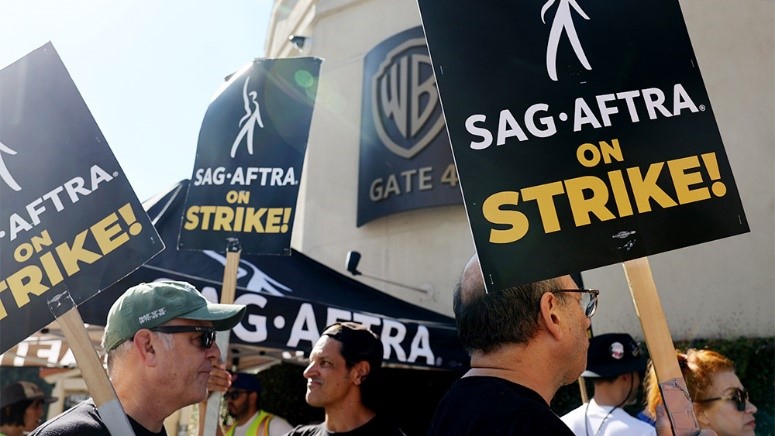
On the 9th of November, the members of SAG-AFTRA, an actors’ union in the US comprised of around 160,000 individuals in the entertainment industry, voted unanimously to end a 118 day strike which has heavily impacted box-office numbers and film release dates. The first week of November has been a clear indicator of this. The sci-fi epic Dune: Part Two was set to release on Friday 3rd November. However, Warner-Bros Discovery opted to postpone the launch so as to wait for actors to raise awareness for the film release once the strikes were over. The film will now release on the 1st of March 2024 and as a result, the weekend following suffered extremely, with Five Nights at Freddy’s leading the pack (grossing $19.3 million in the US). Whilst the strikes have clearly impacted the cinema industry, there were many reasons why they were a necessity.
In today’s technologically advanced society, there has been growing concerns and rumours about Artificial Intelligence’s impact on many industries. Film has been notably affected by this. In May 2023, Marvel Studios released an introduction to its Secret Invasion series created wholly by AI; this led to a wave of backlash as artists could be potentially made redundant. However, most considerably, actors have been worried as to whether they could be replaced entirely. Studios are now able to create digital replicas of actors, which could serve as fully functioning replacements after just one scan. President Drescher of SAG-AFTRA claimed that AI poses “an existential threat [to the] creative professions” and has many reasons to support her views.

Marvel’s highly controversial introduction to Secret Invasion, courtesy of AI
Streaming has become increasingly popular nowadays as well, with the likes of Disney+, Netflix, Prime Video and Max all battling it out to bring the best, and most highly sought after, movies to the small screen. However, during COVID lockdowns especially, more and more movies have skipped the big screen entirely (Black Widow for example). Residuals are long term payments to actors who have worked on films/TV shows which rerun or are streamed. Whilst streaming services do pay residuals, the amount they pay is often too little. As a result, the new contract calls for what is deemed as a “success payment,” which will be given to actors who work on projects with high viewership numbers. This payment is made using a success metric, which is calculated by dividing the domestic views by the total number of domestic subscribers. If the result is greater than or equal to 0.2, then the success payment is made. 75% of this goes to the performer whilst the remaining 25% goes into a payment distribution fund to compensate performers who work on streaming shows. Overall, this is a highly justifiable amendment to help struggling actors through this period of economic turmoil.
There are many other new benefits of this agreement, including the disclosure of viewership statistics; the creation of a minimum number of background actors along the West Coast (so as to equal the minimum number in New York); relocation bonuses and even a 7% increase in wages! In July 2024, there will be a 4% follow up increase and another 3.5% increase will be given starting from July 2025.
With the contract finally ratified, actors, audiences and studios can breathe a collective sigh of relief. Actors can return to publicising their latest creations, studios will make larger profits and audiences are now able to relax, knowing that it is unlikely that their most anticipated films will face further delays (Dune: Part 2, for example). The WGA strikes concluded months ago and with this latest move, productivity can be unhindered in Hollywood, at least for the time being.
Whilst many were in support of the cinema industry during the period of industrial action, others were not as happy. Some would say that actors should have gone on strike due to the sheer volume of issues they face which, unfortunately, would otherwise have not been rectified as quickly. However, not all of my peers agree with this. “The actors have no right to strike. It is their fault, going into a profession that is known to not be lucrative to most who go into the profession,” says an anonymous L6 student. Whilst it is fair to say that actors should be aware that not all of them will make the final cut and become global icons, many others would argue that this is no reason to stop them from highlighting their views. AI is going to become increasingly prevalent in the following decades and as such, they deserve the right to fight for their livelihoods.




 The 1509