
By Tate Brooker
What is a Black Hole?
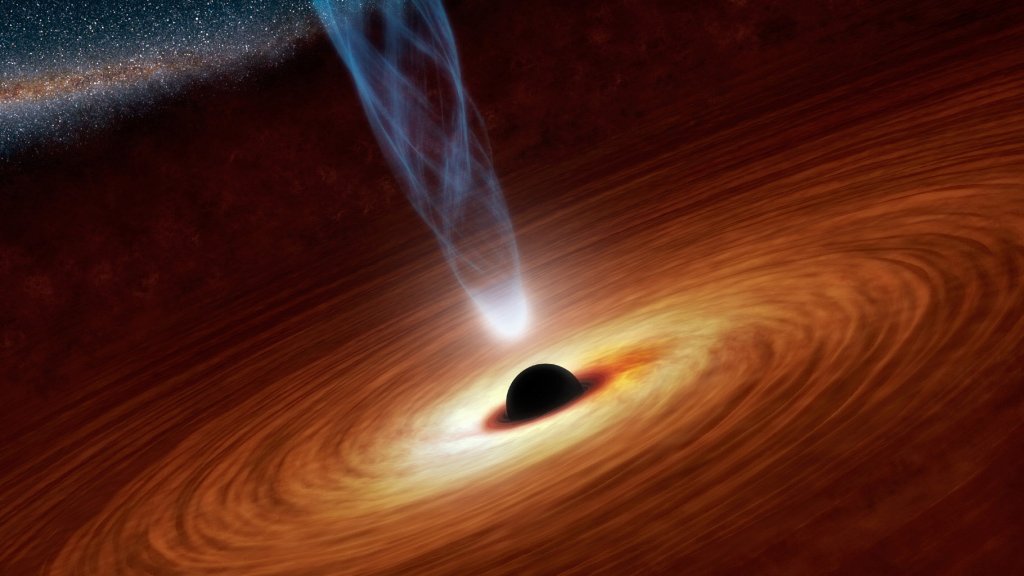
A black hole is an object that has been squeezed past a certain size, called the Schwarzschild Radius. A black hole is so dense and has so much gravity that nothing, not even light can escape it. Anything that gets to close to a black hole gets sucked in forever, never to return. The point where nothing can escape anymore is called the event horizon. Around many black holes, there is an incredibly bright disc of particles orbiting the black hole at incredible speeds. This area, called the accretion disc, is the reason we can locate black holes. Since a black hole emits no light, they are invisible to us, but the accretion disc surrounding the hole signifies where the black hole is located.
The Ergosphere and the Black Hole Bomb
Inside a black hole, time and space are completely broken. Surrounding a spinning black hole, a region called the ergosphere is present. Inside the ergosphere, space and time are only half-broken. If an object enters the ergosphere, it is shoved round and round … and round. This motion is powered by a black hole bending space. If a rocket is sent into the ergosphere, it can gain kinetic energy and escape with more energy than it started with. If a structure made of mirrors was constructed encasing a black hole and a beam of electromagnetic radiation was shot inside, it would bounce around, gaining energy. When released, this energy could be harnessed. If the radiation was not let out, it would eventually shatter the mirrors with immense force, which would create the largest explosion any living being could create.

What Happens If You Fall Into a Black Hole
A lot of people seem to ask themselves this, but why? Are black holes popping up in gardens across the globe? Are parents worried about letting their children run around near a black hole at the local playground? No, of course not; that would be silly. The main reason for this question is that nobody has been in a black hole, so nobody really knows exactly what happens. But we can make a few guesses! For the purpose of science, grab someone random and throw them in. I chose my acquaintance Bartholomew. In the name of science, let’s observe what happens to him. Also, be prepared to say goodbye to your so-called ‘friend’ forever.
Bartholomew’s Deadly Journey
When you throw Bartholomew into the ergosphere, he will be shoved and forced to twirl around the black hole, but if this black hole is small and not spinning, Bartholomew will be spaghettified. This is a fancy science term that means getting stretched feet first into an immensely thin stream of atomic mush, and of course Bartholomew dies. In a large black hole, Bartholomew will soon enter the infinite circle of light. This is a point where light perfectly bends around the Black hole, so whichever direction you look, you see the back of your head. Soon Bartholomew will go inside the event horizon and will be gone forever. Boo hoo.
Destroying the Black hole!
Now you’ve probably decided to avenge Bartholomew after he died from the black hole, so let’s destroy it! This is harder than it seems, as any bombs or weapons of destruction will simply be lost without a trace. There are two theoretical ways to destroy a black hole. First, we destroy the event horizon. To do this we have two options to overfeed the black hole. We either let it suck up lots of charged particles or use kinetic energy of objects to make it spin too fast and shatter. Either way is risky because we need to put all this matter in in one go. Once we do that there will no longer be any event horizon. The result will be what is known as a naked singularity. The problem is that they probably can’t exist, and if they did, it would break the laws of physics everywhere. Nothing would become predictable, so at one moment everyone’s heads might turn to pretzels, or the Sun could turn into a huge disco ball and shoot lasers at Mars. The universe itself would most likely end. The second, less universe-destroying way is to wait. A long time. Imagine an hourglass filled with one grain of sand. Every hundred billion years, one grain falls. When the glass runs out, the black hole would have lost less than 0.0000000000000001% of its mass. That would be how long it takes to destroy a black hole.




 The 1509