
By Marcus Perkins
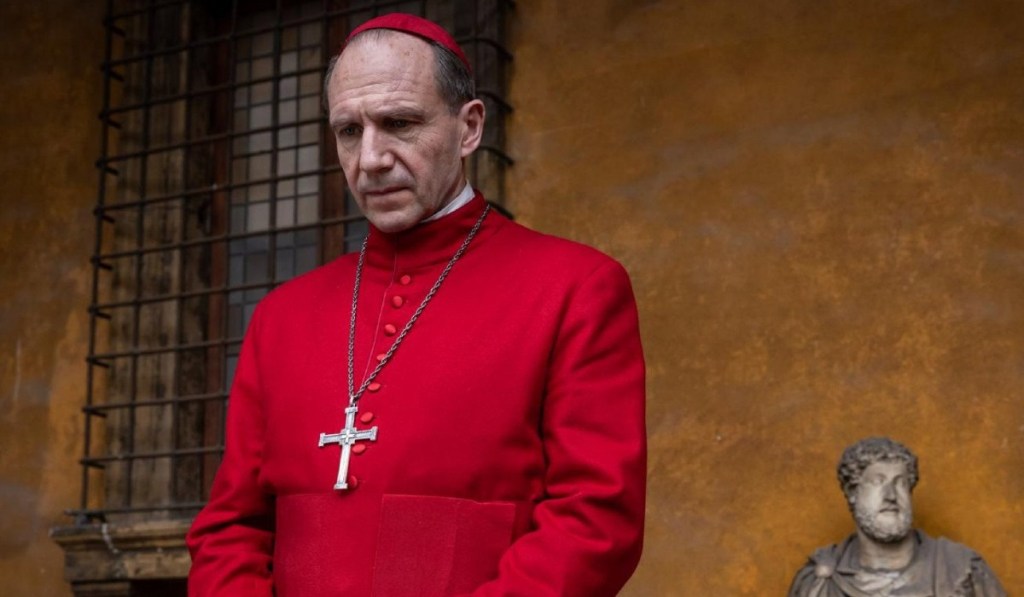
Like many others, after the death of the late Holy Father, Pope Francis, I watched the 2024 movie Conclave, adapted from the 2016 book of the same name, hoping to better understand the process of electing a new Pope.
It proved revealing. The political intrigue that surrounds the calm but assertive protagonist, Cardinal Thomas Lawrence, in his quest to facilitate the papal conclave, offers a deeply insightful glance into the complexities of the Catholic Church today. Angus MacDonald, writing for PoliticsHome, called the film ‘a gripping watch, quietly intriguing and thoughtful’. If you haven’t seen it, I highly recommend it. Just be warned, minor spoilers follow.
That said, I would avoid treating Conclave as a like-for-like portrayal of the Church. Many viewers have criticised its depiction of Church politics, including some who have generally praised its representation otherwise, others accusing it of lacking in character development and emotional depth. Still, one particularly compelling theme lies in the presence of various thematic dualities that shape the narrative:
- How Lawrence is required to act a ‘manager’, in spite of his wishes to be a shepherd—taking direct action to block certain candidates and protect his flock, so to speak
2. How the Church is shown to be intrinsically European, and Italian at that, yet is composed of so many other nationalities and ethnicities—mirrored in Cardinal Benitez’s partially Spanish blessing, echoing the first papal speech of Pope Leo
3. How uncertainty is interwoven with doubt to create a space in which faith is necessary.
The last idea especially stayed with me. It’s not something I had seriously considered before—many people, both Christians and atheists alike, assume that absolute certainty and dogma—defined as beliefs accepted without doubt—are necessary to Christian faith.
Conclave challenges this assertion. In one of the film’s most striking moments, Cardinal Lawrence proposes: ‘Our faith is a living thing precisely because it walks hand-in-hand with doubt. If there was only certainty and no doubt, there would be no mystery. And therefore, no need for faith. Let us pray that God will grant us a Pope who doubts.’
This is more than a memorable quote. It speaks to a growing theological current in Catholic, and, to a broader extent, Christian thought—the idea that doubt is not the enemy of faith, but its companion.Pope Francis himself reflected on this concept. In an interview with Marco Pozza in 2021, the Pope said: ‘The devil puts doubt in us, then life happens along with its tragedies: ‘Why does God allow this?’ But a faith without doubts cannot advance. … Crises of faith are not failures against faith. On the contrary, they reveal the need and desire to enter more fully into the depths of the mystery of God. A faith without these trials leads me to doubt that it is true faith.’
The theoretical chemist and convert Neil Shenvi divides faith into three parts: awareness of the gospel’s existence, intellectual belief that the gospel is true, and personal trust in the gospel. He argues that it is this personal trust, or fiducia, that matters most in biblical faith. Doubt may weaken intellectual uncertainty, but it also heightens the need for an underlying commitment of trust, strengthening that third component of fiducia.
In that way, Conclave does more than dramatise ecclesiastical politics. It helps to correct a number of common assumptions.
A Christian who believes in God, or, for that matter, any theist who believes in a divine being, is not and should not be intellectually certain. An atheist that bases their disbelief off of doubt misunderstands that the same doubt, placed in a different context, can strengthen a believer’s faith. The difference isn’t doubt, it’s trust. This idea has cultural and political implications too. Paul Sloane for The Catholic Union notes that whilst politicians are often rewarded for unwavering confidence, those who admit uncertainty are dismissed as weak or indecisive. The same mindset affects religious leadership, and this tension is reflected in Conclave.
After Lawrence’s homily on doubt, Cardinal Tedesco, a conservative Italian, casts him wary glances, and whispers in Italian can be heard whilst Lawrence speaks. Later, Lawrence’s assistant tells him, ‘Your homily has caused quite the stir.’ The idea that Church leaders should doubt is controversial.
To me, there is something profoundly wrong with this. Is uncertainty really a lack of conviction? Or is it the humility to recognise that we are not perfect, that we make mistakes, and that we are responsible when we do so?
In matters of faith, is doubt not simply the recognition that we are not God?
In the context of the papal conclave, the Church needs not the loudest voice or the clearest ideology—it needs the humblest: one who accompanies rather than judging; one who walks beside rather than ahead; one who doubts, precisely because they believe.


 The 1509
Leave a comment