
By Spandan Sahu
The word “woke” has been carelessly tossed around by Republicans and right-wing politicians since 2015 (not a coincidence that this is when Donald Trump became prevalent in US politics), used to categorize any set of ideas that are politically correct in contrast to some rather ridiculous far-right opinions. This article is mainly a delve into the origin of the term “woke” and how the subsequent “woke agenda” has allegedly corrupted all aspects of the media.
So, first of all, how do we define this adjective “woke”? In apolitical terms, this is nothing but the past tense of the verb to wake, and this is generally where we can trace the origins of the concept of being “woke” to. Woke originally meant being “awake” to racism in society, and this was further diluted to mean anyone fighting any form of prejudice. Yet now, Democrat and left-wing politicians avoid any mention of this term, as being “woke” has been weaponized by the right to refer to an ardent activist, this so-called “woke warrior” who has the worldview of there being only two types of people; the victims and the oppressors. This perspective alone isn’t wrong, but it can result in extremities such as reverse discrimination and the policing of speech, both of which are naturally seen to be interventions upon basic human rights.
Following on from this, we must search for a definition of what the right claim to be the “woke agenda” is, so we can analyze its effects on the media. JD Vance, the US vice presidential nominee for the Republican Party, repeatedly uses the term “woke nonsense” to describe anything that ideologically opposes the right; however, one could assume that this seems to be against the BLM movement, LGBTQ issues, and combating any social injustice, as although the right isn’t explicitly anti-black, there is the strong belief that the social framework already exists for impoverished black communities to hoist themselves out of poverty into the middle class. Hence, the woke agenda in the media must be the raising of awareness for these issues, which the right clearly opposes; a candidate for the Republican nomination during the primaries, Vivek Ramaswamy, strongly holds the belief that there are “only two genders” and that the nuclear family should consist of only one man and one woman; most of all, he presses the message that this concept of wokeness should be eliminated from all American politics.
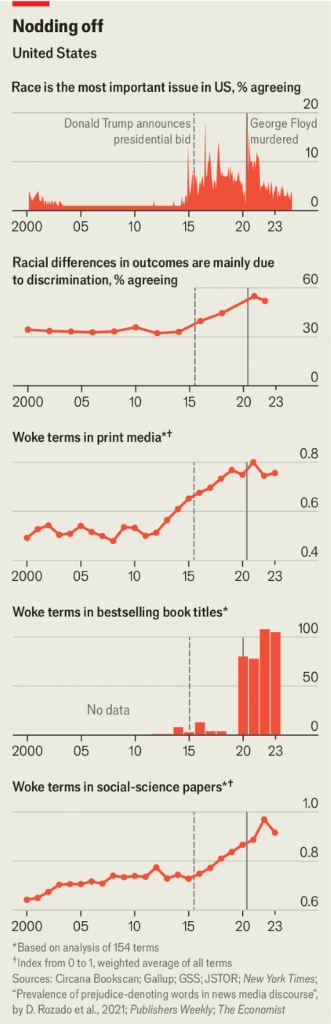
The Economist recently conducted a study on the frequency of the use of work terms in journalism; their sample consisted of words such as “intersectionality” (how interconnected social identities are and the effect this has on oppression), “microaggression” (verbal, behavioral, or environmental slights that intentionally or unintentionally communicate derogatory attitudes), “oppression” (prolonged cruel or unjust treatment or exercise of authority), “transphobia” (derogatory attitudes towards a transgender person), and “white privilege” (advantages possessed by a white person in a society that is characterized by racial injustice). These are a few out of 154 words that were counted across 6 newspapers, Los Angeles Times, New York Times, New York Post, Wall Street Journal, Washington Post, and Washington Times—between 1970 and 2023. In 2020, “white privilege” was seen 2.5 times every 1 million words; yet last year, in 2023, this number dropped to 0.4. We can conclude that “woke ideas” are dropping, as using transcripts from television news channels, wokeness peaked in 2021, and in popular books, 2022. So far, in 2024, there has been a significant drop in these woke terms across all media. The Acolyte TV show has received significant backlash for not following Star Wars canon and propelling “woke” characters; this is generally condensed into the one lesbian couple who seem to be protagonists in the show, and the clear lack of a single white male character.
Wokeness is not the pressing issue that the right makes it seem to be; issues of prejudice and oppression must be addressed by the US government and all governments in the world, but the general consensus agrees that it is wrong to push this message while compensating the quality and writing of a show, book, and general journalism.



 The 1509
Leave a comment