

By Leo Manolis
Apart from the occasional shooting fixture, or weekend detention, on a normal Saturday, the RGS building is completely empty. But on the 15th of November, more than 300 students and teachers from 20 schools will be filling the RGS’s hallways and classrooms for the school’s 6th Model United Nations (MUN) conference: RGSMUN VI.
What is MUN?
Headed by Ayaan Bhagat, MUN is one of the RGS’s largest societies, with over 40 pupils attending every Thursday lunchtime. Students act as countries “delegates”, learning public speaking, how to debate, and think on their feet. Delegates are presented with global issues – which can range from regulating mercenary companies, to passing new international treaties on cyberwarfare – and must write resolutions to solve them: they can form investigative committees, authorise invasions, or impose sanctions on rogue states. Spandan Sahu, an Upper Sixth who is the Deputy Secretary General, describes Model United Nations as, “intense yet enjoyable”. You learn about geopolitics and international relations, how to confidently research complex topics, and improve your knowledge of the world.
What happens at the conference?
At the conference, the 300 ‘delegates’ will be placed into separate committees which are modelled after the real UN structure. Delegates could represent Denmark in the Human Rights Committee and castigate the practice of torture, or act as Russia in the Security Council, and veto condemnations of their own human rights violations.
Each committee is headed by a pair of older students, normally Sixth Formers, who act as ‘chairs’ – there are usually no more than 18 people in a committee, so everyone gets a chance to speak. In committees, they debate resolutions written and submitted by the delegates themselves, addressing their committee’s own unique issue. Delegates will negotiate with each other during ‘lobbying’ to form ‘blocs’, alliances of like-minded countries. They can agree to speak in favour of each other’s resolutions or target certain opposing countries in their speeches.
At the end of the day, when the committees finish their debates, the delegates go into the Great Hall for the ‘General Assembly’ (GA). All 300 students gather for a massive debate discussing a crisis. Previous crises have involved alien invasions and kidnappings of major world leaders. In the GA, you form massive alliances with countries from all over the globe and get to give speeches and take questions in front of 300 people to solve the crisis at hand – public speaking as advertised.
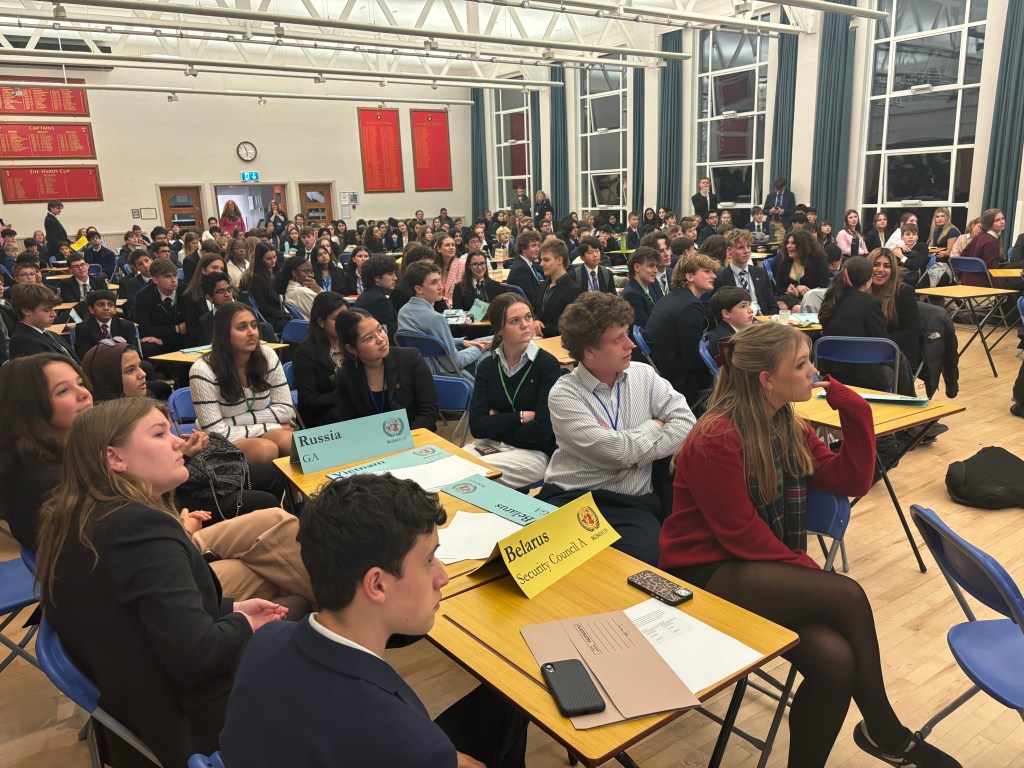
It isn’t all just debating.
But conferences aren’t all about formal debate and parliamentary procedure: delegates often go completely off topic, and twist topics in ridiculous ways to justify outrageous solutions. A fond memory of mine is when a resolution was passed recommending the nuking of Qatar to end illegal fishing, or when we renamed Kazakhstan to Boratland to end border tensions. (We assumed no one would dare invade such an amazingly named country). No matter the topic at hand, there will always be a North Korean delegate who’ll find the opportunity to threaten nuclear war on the Supreme Leader’s enemies. Once, a North Korean delegate brought a portrait of Kim Jong Un and kissed it every time he spoke.
In between the debating – serious or not – there are also many opportunities for socialising and meeting new people: Spandan says, “I’ve made friends for life”. There’s a lot of banter and light-hearted moments, despite how serious we try and make it seem. When committee debates are over, but before GA, delegates vote to assign each other joke awards such as ‘most likely to be a dictator’, ‘most likely to start WW3’, and ‘best dressed’, to name a few. Throughout the day, people regularly share contact details, and I, like Spandan, have made a lot of friends there.

Why should you join MUN and go to conferences?
Other than learning important life skills and meeting new people, MUN can be a source of awards and fancy titles for you to achieve and celebrate. Delegates who contribute the most to committees, be that with resolutions, speeches, or collaboration, get ‘Outstanding’ or ‘Highly Commended’ delegate awards. If you attend MUN regularly, in upper 6th you may end up running the society – universities get extremely impressed when you run a society, especially one that requires organisation and commitment to such an extent. Ultimately, you should join MUN because it’s enjoyable and has something for everyone. It’s not as narrow and structured as normal debating, and the topics are extremely relevant to current affairs. Going to conferences gives you the practice and confidence for public speaking that is vital for your adult years – it’s best to iron out any fears of giving speeches while you’re young. Just take it from someone who has been going to MUN since 1st form and has been to a dozen conferences: come to MUN Society, sign up to the conferences, and I promise you won’t regret it.




 The 1509
Leave a comment